

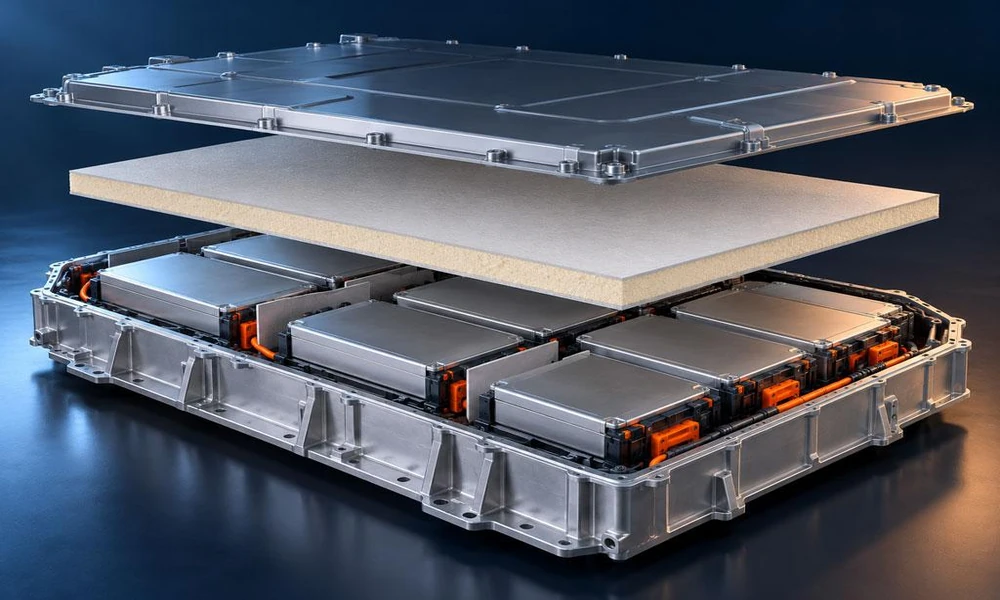
Every protective layer inside an electric vehicle battery occupies space and contributes mass. Removing that layer may simplify the package, but it also removes whatever function the layer was intended to provide.
This creates a practical design problem: how can a battery meet its protection requirements while using the available weight and volume effectively?
The answer begins with a precise description of each material’s role. A lightweight panel, a thin between-cell barrier, and a structural enclosure should be evaluated against their own requirements before their weights are compared.
Compare finished parts rather than material labels
Density is useful, but it does not tell the whole weight story. A low-density material used in a thick construction may weigh more per unit area than a denser material used in a much thinner section.
Facings, adhesive layers, reinforcements, and attachment features also contribute to the installed component. For early comparisons, engineers should therefore calculate the mass and occupied volume of the proposed finished part, using the actual drawing rather than an isolated material property.
This helps make trade-offs visible. A candidate that appears attractive as a bare sample may need additional layers or support once incorporated into the assembly.
Put thermal resistance where it is needed
Battery thermal management requires selective heat flow. Heat should move toward the intended cooling system during normal operation, while protective barriers may be needed along paths that could expose neighboring components during an abnormal event.
That is why the location of insulation matters. A promising material cannot be judged independently of the surfaces it covers, the edges it leaves exposed, and the other routes through which heat could travel.
At the concept stage, a simple map of these functions can be valuable: cooling contact here, electrical separation there, and thermal protection at a defined boundary. This prevents one material from being assigned several conflicting jobs without evidence.
Different constructions address different packaging problems
PIR thermal insulation cushioning board is described as a composite combining modified rigid polyurethane foam with inorganic facing materials. The company positions it for lightweight insulation and cushioning, with its battery solution page identifying pack-level protection as an application.
For a different location, Nano-silica composite thermal insulation board is described for thermal protection between battery cells. This makes it a candidate for a different design task rather than an interchangeable version of a pack-level composite board.
Comparing the two begins with geometry and function. A construction suitable for a broader panel location may not fit a narrow cell gap, while a between-cell barrier may not provide the mechanical behavior required elsewhere.
Be deliberate about combining functions
A material that contributes insulation and cushioning may simplify an assembly, but fewer part numbers do not automatically mean a better design. Engineers still need to establish that each required function is maintained under the relevant conditions.
For example, compression can change the installed thickness of a compliant component. Facing layers may affect its attachment method and edge design. Openings for fasteners or other components may interrupt an otherwise continuous protective surface.
These details should be included when evaluating a multifunctional construction. They are part of the component’s performance, not secondary finishing decisions.
Validate the chosen construction
Once the design is defined, testing should reflect the intended assembly and its relevant loads and exposures. [UL Solutions describes thermal propagation and other EV battery evaluations at cell, module, and pack levels. Material properties support that process but do not replace it.
Weight reduction is most useful when the resulting design still satisfies its requirements. For protective battery materials, that means accounting for the complete installed part, placing it deliberately, and verifying the final construction. A material earns its place in the pack through the function it delivers within that design.
